Chickenizing Farms and Food by Ellen K. Silbergeld
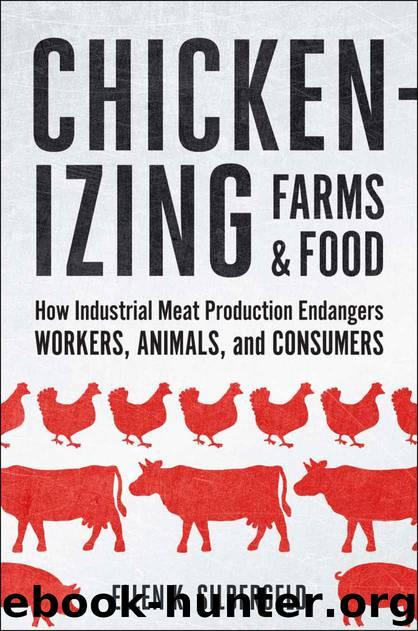
Author:Ellen K. Silbergeld [Silbergeld, Ellen K.]
Language: eng
Format: azw3
Publisher: Johns Hopkins University Press
Published: 2016-09-25T04:00:00+00:00
HUMAN ECOLOGY
The transformation of agriculture into industry has also impacted human ecology, particularly in rural communities. This is not in itself new; as noted earlier, rural communities have been in continuous flux throughout post-Paleolithic history, but it is a significant threnody in the complaints about industrialization of agriculture as well as of other human works and days since the earliest steps in technology.
It is indisputable that the traditional social structure of rural communities has been altered over the past seventy years, mostly for worse. But this is only the most recent chapter in a long social and economic history of farming in America, following a sudden, sharp shock to the system delivered by industrialization starting in the early 1920s. Farming by smallholders or independent entrepreneurs is valued because it sustains a local focus for rural communities, whereas sharecropping and contract agriculture insert physical and socioeconomic distance between producers and communities. In a way, we have reverted to an earlier social arrangement of agriculture, similar to the hegemony of absentee landowners in premodern society (and in late modernizing countries such as Portugal and Russia) and in societies subject to foreign domination by colonial powers. Those arrangements were almost exclusively to the economic benefit of landowners, in line with the distribution of other forms of power.
But not all farmers in preindustrial times were self-employed entrepreneurs. Salaried workers have always augmented the efforts of owner-operators and their families in agriculture. Prior to wage labor, forced labor was imposed by peonage or slavery or by economic means of indenture and land rents. The latter has vestigial traces still evident in some of the first colonies in North America, such as Maryland, where it is possible to own a house but to have to rent the land on which it was built. Centuries of a tradition—a harsh one—have created two opposing forces, a drive for emigration that has powered movement of peoples from the country to towns and cities since the Neolithic Age and, at the same time, for others, robust and meaningful ties to rural life and agriculture. The folk traditions of Ireland exemplify this tradition: the desperation of the rural poor tied to absentee landowners and the movement off the land to cities and other countries contrasted with the deep emotional life of some of these communities such as the Blasket Islands. One does not obliterate the other, but often the memory obliterates the reality of what has been left and lost. Returning children of the émigrés often experience these tangled feelings, from the great-grandchildren of the Irish famine to those of the southern Italians who emigrated after being forced off their land by local despots. Now the condition of farm ownership today in the United States is more often one of rental or lease, replacing family ownership.
Industrialization has imposed a rough bargain between farmers and capitalists. The new sharecropping regime shifts much of the risks of independent farming to corporate enterprises (by guaranteeing payments for the product), but it removes the traditional autonomy of independent farmers and their direct engagement in the marketplace.
Download
This site does not store any files on its server. We only index and link to content provided by other sites. Please contact the content providers to delete copyright contents if any and email us, we'll remove relevant links or contents immediately.
The Brazilian Economy since the Great Financial Crisis of 20072008 by Philip Arestis Carolina Troncoso Baltar & Daniela Magalhães Prates(303519)
International Integration of the Brazilian Economy by Elias C. Grivoyannis(111312)
The Art of Coaching by Elena Aguilar(53415)
Flexible Working by Dale Gemma;(23319)
How to Stop Living Paycheck to Paycheck by Avery Breyer(19778)
Thinking, Fast and Slow by Kahneman Daniel(12416)
The Acquirer's Multiple: How the Billionaire Contrarians of Deep Value Beat the Market by Tobias Carlisle(12377)
The Radium Girls by Kate Moore(12089)
The Art of Thinking Clearly by Rolf Dobelli(10597)
Hit Refresh by Satya Nadella(9185)
The Compound Effect by Darren Hardy(9052)
Tools of Titans by Timothy Ferriss(8490)
Atomic Habits: Tiny Changes, Remarkable Results by James Clear(8406)
Turbulence by E. J. Noyes(8112)
A Court of Wings and Ruin by Sarah J. Maas(7944)
Change Your Questions, Change Your Life by Marilee Adams(7847)
Nudge - Improving Decisions about Health, Wealth, and Happiness by Thaler Sunstein(7758)
How to Be a Bawse: A Guide to Conquering Life by Lilly Singh(7545)
Win Bigly by Scott Adams(7255)
